
Core objects
Every JustRelax model is built from the same handful of containers, allocated once at the start of a script and threaded through the solver calls. This page introduces them; the field-by-field listing lives in each type's own docstring.
StokesArrays
StokesArrays holds everything the Stokes solver reads and writes: velocity (V), pressure (P), the deviatoric stress and strain-rate tensors (τ, ε), viscosity (viscosity), the momentum/continuity residuals (R), and, depending on the physics enabled, displacement (U), vorticity (ω), and plastic strain accumulators (ε_pl, EII_pl).
stokes = StokesArrays(backend, ni)V, τ, ε, and viscosity are themselves small structs (Velocity, SymmetricTensor, Viscosity) rather than raw arrays, so a component is always accessed by name:
stokes.V.Vx          # x-velocity, on cell faces
stokes.τ.xy           # shear stress, at vertices
stokes.viscosity.η   # viscosity at cell centers
stokes.P              # pressure at cell centers
ThermalArrays
ThermalArrays is the heat-equation counterpart: temperature (T, Told), the diffusive flux (qTx, qTy, qTz), the residual (ResT), and source terms (H, shear_heating, adiabatic).
thermal = ThermalArrays(backend, ni)
thermal.T[i, j]      # temperature at cell centers, with ghost nodes
Pseudo-transient damping coefficients
The Stokes and heat solvers are pseudo-transient (PT) iterative schemes; each needs a set of damping coefficients derived from the grid and a target Reynolds number. PTStokesCoeffs and PTThermalCoeffs compute these once, from li and di, and are passed straight to solve!:
pt_stokes = PTStokesCoeffs(li, di; ϵ_rel = 1.0e-6, Re = 3π, CFL = 0.9 / √2.1)An experimental alternative, DYREL, replaces the constant PT coefficients with self-tuning ones and is instantiated from the viscosity field instead of li/di alone — see Using the APT method with auto tuned damping coefficients for its own constructor and solver call.
Phase ratios
Multi-phase models track, at every grid location, what fraction of each material phase is present. PhaseRatios (from JustPIC.jl, re-exported here) stores these fractions at cell centers, vertices, and the staggered velocity nodes; phase_ratios.center and phase_ratios.vertex are what compute_viscosity! and compute_ρg! read to blend per-phase material properties.
Staggered-grid field layout
All of the containers above share one staggered-grid convention: pressure, temperature, and the diagonal stress/strain-rate components live at cell centers. Temperature includes one ghost layer on each boundary. In 2D, the off-diagonal (shear) components live at cell vertices; in 3D they live on edges (for example, τ.xy has size (nx + 1, ny + 1, nz)). Velocity and flux components live on the cell faces they cross.
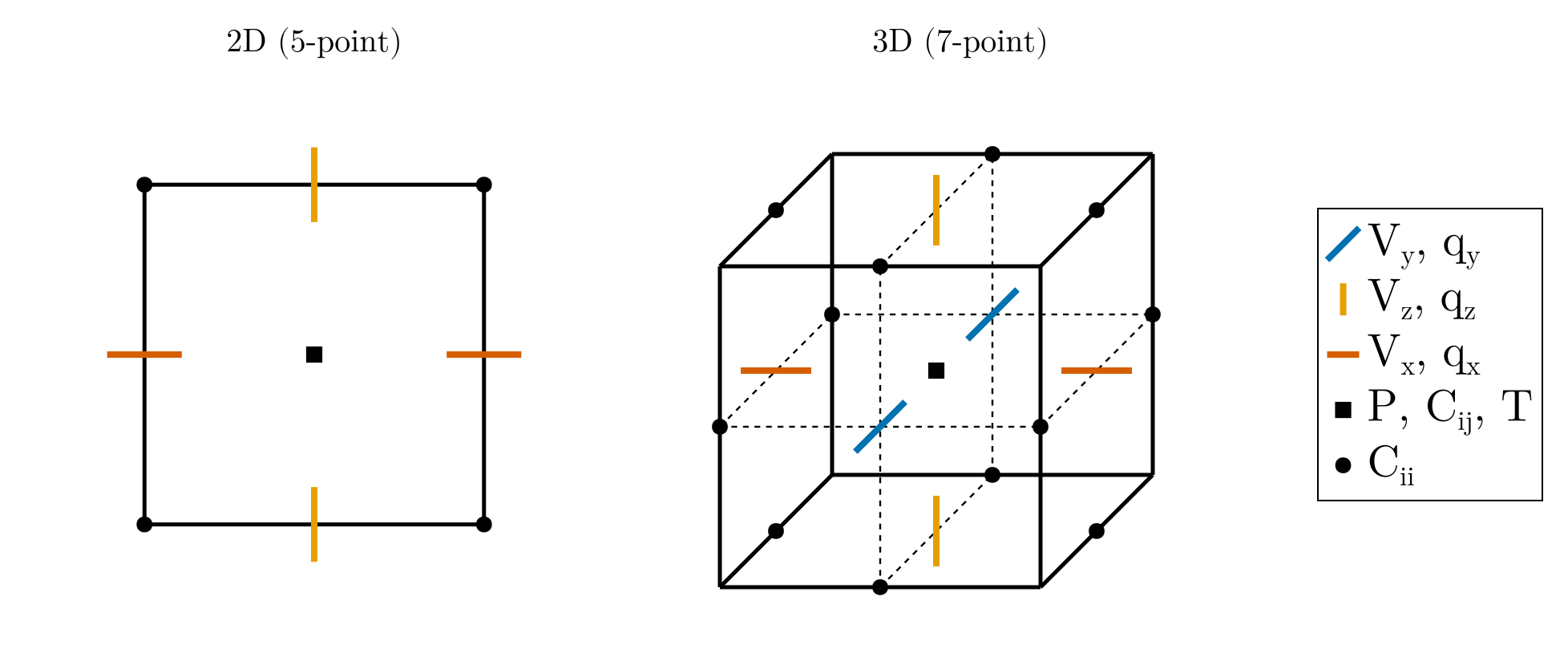
This is also the layout PhaseRatios and the grid coordinates returned by Geometry (xci vs. xvi) follow — see Grid generation.